Peptide Quality Control & Purity Screening Boc Scientific Researches
What Is Peptide Purity And Why Does It Matter In Research-grade Peptides? Qing Li Peptide Research-grade peptides are produced research laboratory research study use just-- they are not created under pharmaceutical GMP standards and are not suggested for usage as therapies or in human beings. These peptides feature a basic quality control bundle, generally including HPLC purity evaluation and MS verification of identity, guaranteeing they satisfy scientific requirements for pureness and make-up. They are classified "for study use only" to make clear that they are meant for artificial insemination experiments or animal researches, except any kind of kind of human usage. If you're utilizing injectable peptides, endotoxin screening gives vital safety information. This is particularly appropriate for injectable peptides where the administration route bypasses typical safety obstacles. Understanding peptide safety and security and dangers consists of understanding that item quality directly affects security results. Researchers regularly examine HPLC and mass spectrometry information.
Is 95% pureness good for peptides?
Peptides with an 85% pureness degree or greater are generally used in enzyme assays or organic task research studies. Peptides with pureness greater than 95% are exceptional for quantitative evaluation.
Absence Of Efficient Approaches For Architectural Modifications And Series Verification
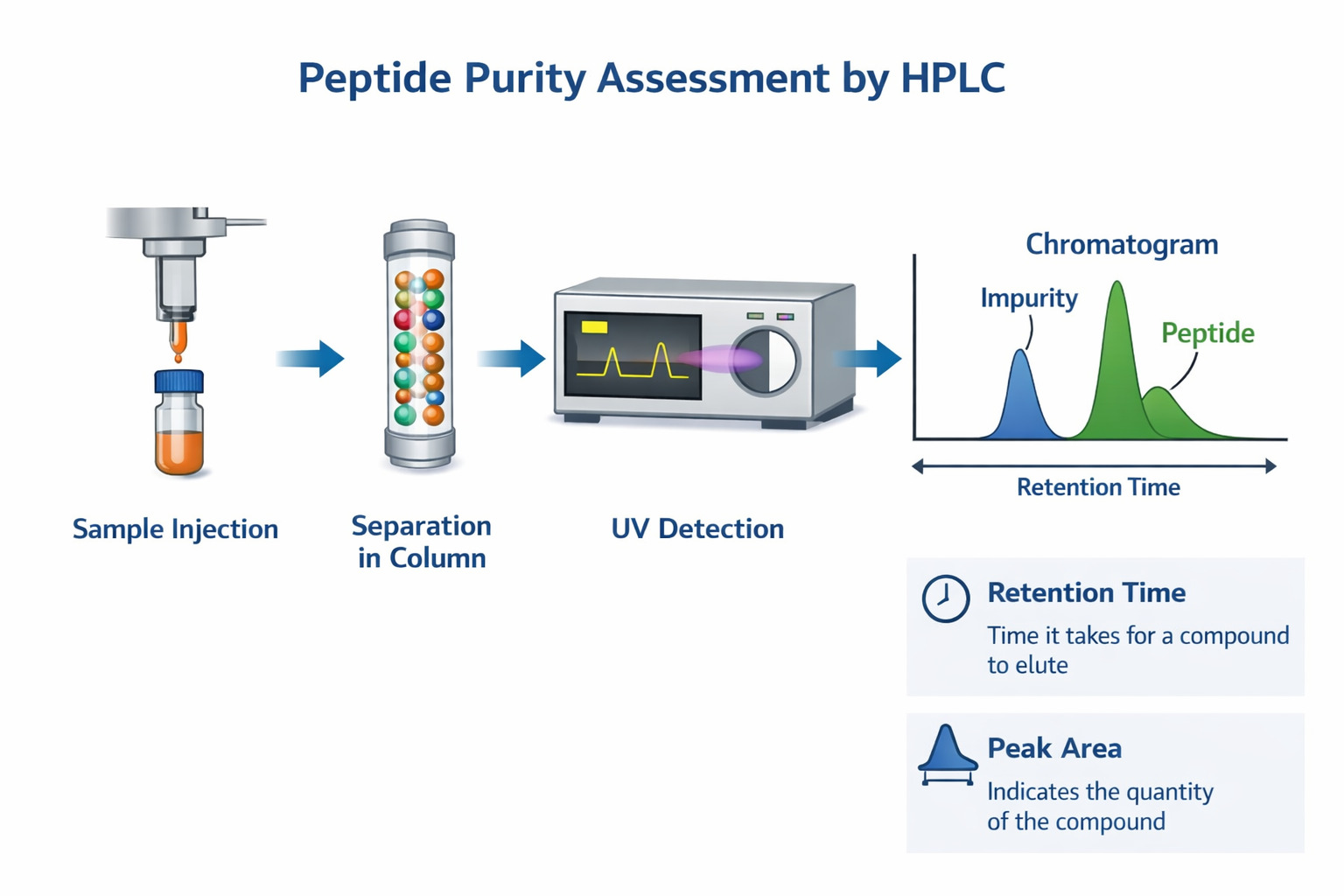
It separates the target peptide from peptide-related impurities (removal sequences, abbreviated pieces, and synthesis by-products). Retention time is the elapsed time from shot to the minute a compound's peak maximum is identified. It is particular of a compound under particular chromatographic conditions (very same column, same slope, very same temperature). Regular retention time throughout sets supplies confidence that the same compound is being supplied. If a distributor's lot-to-lot COAs reveal meaningfully different retention times for the exact same compound, this recommends either a change in substance or a change in chromatographic conditions-- both of which deserve scrutiny.- A substance stated to be 95% pure has 5% of something else-- and in a research study setting, that "another thing" issues.
- Purity screening asks how much of the discovered example is the primary peptide versus related contaminations.
- High pureness is desirable since also small impurities may disrupt speculative results or analyses.
- In concentration-response experiments, these pollutants can change contours, flatten plateaus, or introduce biphasic behavior that covers truth task of the target substance.
- Purity varies widely, from 40% to 80%+ relying on series size and difficulty.
Comprehending The Methods
Before a peptide is used in a research study environment, scientists commonly review testing paperwork to much better understand product identification, pureness specifications, and total top quality standards. With high degrees of experience in carb chemistry and our detailed peptide analysis system, Imaginative Peptides can provide high-quality peptide purity determination services. According to strict analysis quality control and biosynthetic quality assurance standards, each peptide is strictly kept track of during the evaluation cycle. For a 10-residue peptide with 99.5% combining effectiveness, you 'd https://rylancjqt735.dovetailscope.com/posts/peptide-testing-hplc-uplc anticipate about 95% of the end product to be the unabridged series before filtration. For a 30-residue peptide at the exact same effectiveness, that goes down to about 86%. This is why longer peptides are harder to create at high pureness and normally cost more. Browsing the landscape of where to get research peptides online requires a concentrate on analytical transparency and manufacturing roughness. While several platforms act as simple representatives, the most trusted entities keep direct oversight of their synthesis and purification pipelines. Whether you are carrying out first in vitro displays or intricate molecular modeling, choosing a supplier with verified analytical criteria is paramount for reproducible results. We combine LC-MS/MS and enzymatic digestion evaluation to specifically validate the series and alteration sites of non-natural modified peptides. Peptides, with long molecular sequences and diverse conformations, present obstacles for framework confirmation and material resolution. BOC Sciences leverages high-resolution mass spectrometry, LC-MS/MS, and NMR to accurately evaluate molecular structures and give very delicate quantitative assistance.